A coil carrying alternating current is passed near a conductive part, inducing circulating — or "eddy" — currents in the material's surface. A crack, corrosion pit, or conductivity change disrupts those eddy currents, and the resulting shift in the coil's electrical response reveals the flaw — all without any liquid couplant needed.
Because it requires no couplant and reads out fast, eddy current testing is especially suited to fast, repeatable surface inspection where an ultrasonic tank or squirter setup would add unnecessary time to the cycle.
Desktop EddyScanners
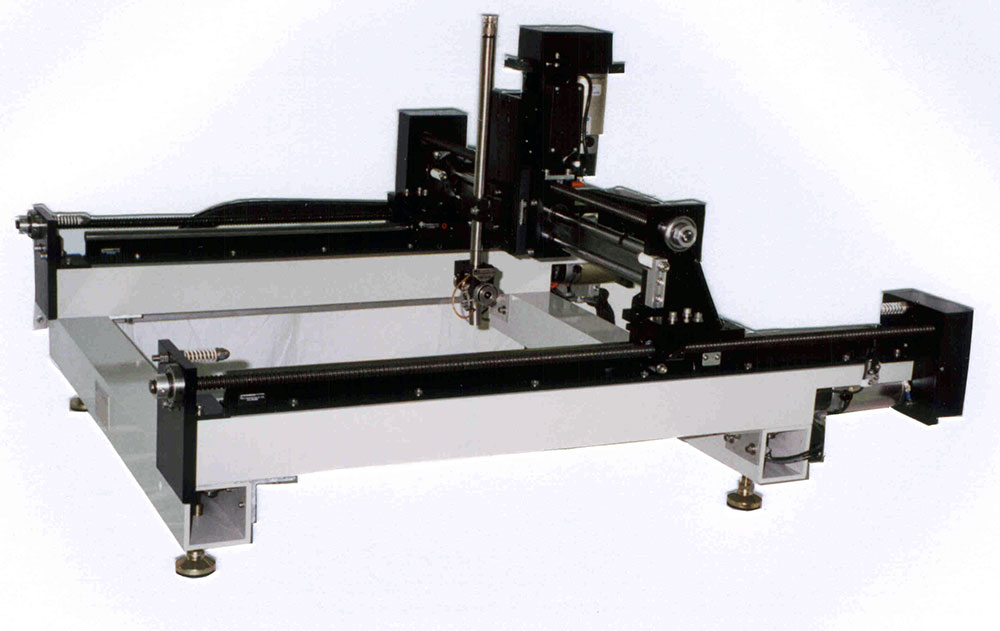
High-performance, servo-driven PC-based eddy current scanners running SDI's MasterEddy motion control and WinEddy acquisition software, with up to eight-channel amplitude logging at 4kHz per channel. The SDI-7105 is a portable frame built for field work with motorized X and Y axes; the SDI-7110 is a heavier-duty benchtop platform for precise probe positioning in applications like turbine component inspection. Both can be extended with a motorized vertical axis, gimbals, turntable, or rotator, and advanced configurations support fully programmable 3D contour following.
Download SDI-7100 Spec Sheet →| SDI-7105 | Portable field frame, motorized X/Y |
| SDI-7110 | Benchtop, precision probe positioning |
| Channels | Up to 8, 4kHz per channel |
| Software | MasterEddy / WinEddy |
Need fast, repeatable surface inspection?
Ask SDI about the SDI-7100 Series EddyScanners.